

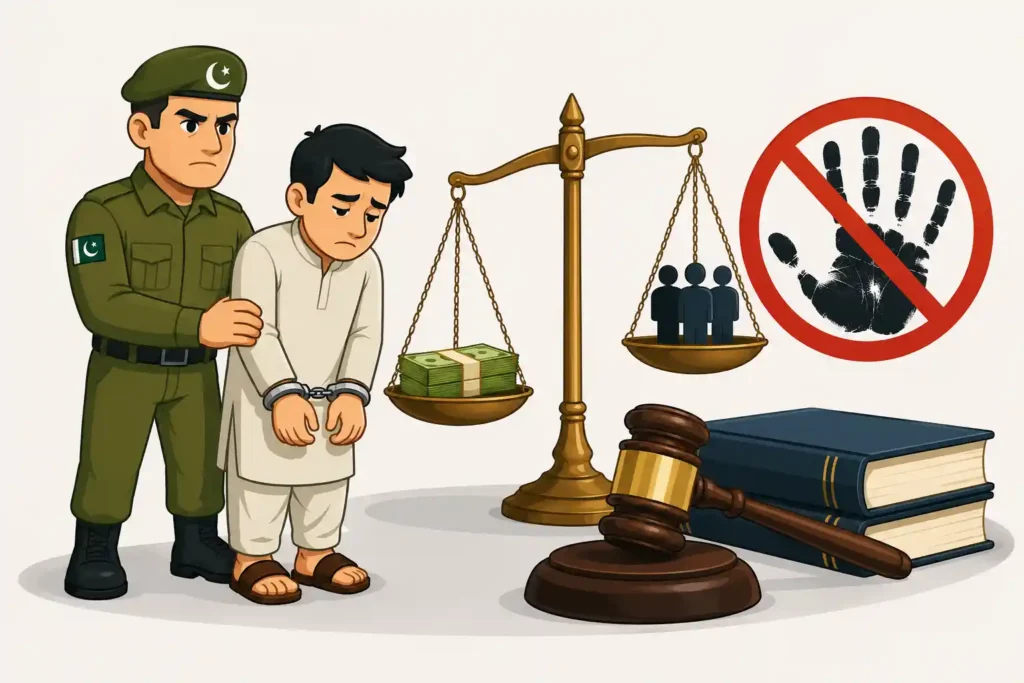
In July 2026, the International Federation for Human Rights (FIDH) published a report called Under the bench: Mapping corruption risks in Pakistan’s justice system. It was produced in collaboration with the Human Rights Commission of Pakistan (HRCP), with support from the Agence Française de Développement and the European Union.
I want to walk through what the report actually says. Not what I think about it. There is a difference, and in this case the difference matters. Everything below is attributed to the report or to the sources the report itself cites. Where I have added anything, I have said so.
You can read the full report on FIDH’s website. It runs to 36 pages, and if this topic interests you, the original is worth your time.
Where the findings come from
The researchers interviewed 30 people. Among them were lawyers, journalists, civil society representatives, and former judges, including two former Chief Justices of Pakistan, former Supreme Court judges, and a former High Court judge. Interviews took place in February and March 2026, conducted in English over a secured videoconferencing platform by a Pakistan-based researcher, Asad Jamal, and a Brussels-based researcher, with assistance from HRCP staff member Salman Farrukh.
Interviewees were based in Lahore, Islamabad, Peshawar, and Karachi. Some had insight into Balochistan. The report is explicit that resource constraints meant the researchers could not gather information on the judiciary in Gilgit-Baltistan or Azad Kashmir.
Four of the 30 interviewees were women. The report notes this as a limitation and connects it to a broader finding: because women are so poorly represented in the judiciary, researchers were able to interview only a small number of female lawyers and no female judges at all.
Because of the sensitivity of the subject, most interviewees spoke on condition of anonymity. All quotes in the report are anonymised.
So: 30 interviews, four cities, one three-month window, self-reported limitations stated up front. That is a qualitative study, and the report presents it as one. It is not a statistical survey of the judiciary. It does, however, cross-reference its interview findings against published data from Transparency International Pakistan, the World Justice Project, the IMF, and UN treaty bodies.
The numbers in the background
Before getting to the interviews, the report sets out publicly available data.
The World Justice Project’s 2025 Rule of Law Index ranks Pakistan 101st out of 143 countries for criminal justice and 129th out of 143 for civil justice. For absence of corruption, Pakistan sits at 123rd out of 143, second to last in the region.
On backlog: in September 2025, the Minister for Law and Justice, Azam Nazeer Tarar, stated there were 2.4 million cases pending nationwide, including over 300,000 before the High Courts and 1.8 million before the District Courts. As of October 2025, the Supreme Court had 56,169 pending cases.
Transparency International Pakistan’s 2025 National Corruption Perception Survey found the police sector perceived as the most corrupt in Pakistan, with the judiciary third nationally. In its 2023 survey, TI Pakistan calculated that the highest average expenditure on bribery was in the judiciary, at roughly PKR 25,846 per instance.
In November 2025, the IMF published a Governance and Corruption Diagnostic Report describing corruption in Pakistan as persistent and corrosive, pointing to weak institutions, elite influence over policymaking, and low public trust. The government then issued a 142-point economic governance reform plan that included judicial reforms.
In its November 2024 Concluding Observations, the UN Human Rights Committee raised concern about reports of corruption at all levels including the judiciary, and about accountability mechanisms for public officials being selectively applied. It also noted the absence of comprehensive whistleblower protection legislation at federal and provincial levels.

The three drivers the report identifies
The report organises its central chapter around three interrelated factors it says enable corruption in the judiciary.
Weak administration of justice
Most interviewees attributed the prevalence of corruption to weak administration and a lack of safeguards that would ensure transparency.
The chain, as the report describes it, starts at the police station. Interviewees reported that bribes were often necessary to file a First Information Report, the preliminary step to any police investigation. One lawyer described a client whose cheque had not been honoured; the police asked for PKR 300,000, roughly three percent of the cheque’s value, to file the FIR. The client paid. The report quotes the reasoning as wanting to cultivate a good relationship with the police from the start, since the same police would run the subsequent investigation.
People were often unwilling to report this, according to interviewees, because of a perception that reprisals would follow and the investigation would suffer.
Once cases reach the courts, the report describes bribes to administrative staff in registrars’ offices to schedule cases before particular judges or benches, to secure specific hearing dates, or to move hearings earlier. It describes bribes to judicial officers to file paperwork, obtain certified copies faster, or in some accounts to remove or forge material on the record.
An overwhelming number of interviewees identified case scheduling as the single largest contributing factor. Judges, and particularly chief justices and registrars, have wide discretion over which cases are heard, when, and by whom. The report’s argument is that this discretion cuts both ways: litigants with resources can pay to have a hearing scheduled quickly, or to ensure it is not scheduled at all, depending on which serves them. The backlog creates the incentive, and cases kept deliberately pending feed the backlog.
On safeguards, some interviewees said technical fixes had not worked. Glass walls in registrars’ offices and CCTV in courtrooms simply moved the exchange elsewhere, to bathrooms or off the premises entirely. The report adds a May 2026 finding that a high proportion of court CCTV cameras were malfunctioning, including roughly half at the Karachi City Courts and all 77 at the Rawalpindi District Courts complex, along with the monitoring control room.
Not every interviewee agreed on scale. A small number believed the perception of financial corruption exceeded its actual incidence, and that some lawyers exploited that perception. Some noted that a bribe being accepted did not guarantee a judgment would follow. One lawyer told the researchers it was a complicated picture.
But on normalisation, the report says interviewees were unanimous. One lawyer quoted a saying he had heard often in Pakistan: that people do not hire lawyers, they hire judges. The report also notes that unclear official court fees leave litigants unable to tell which payments are legitimate charges and which are not.
Cultural dynamics
Here the report makes a claim I found the most interesting, because it cuts against the assumption that corruption is mainly about money.
While all interviewees recognised financial corruption as a problem, the majority said that the use of influence and social networks was more prevalent, more widespread, and arguably more damaging.
The report describes a culture of exchanging favours, with strong expectations that someone in a position of power will help family members and personal acquaintances. It quotes a lawyer describing the fear of annoying a judge you appear before, and of annoying peers, as a lawyer’s biggest professional fear.
Interviewees reported that judges gave more favourable treatment to senior or well-connected lawyers. One described influence being exercised through other judges, with a senior judge asking a subordinate to look out for a particular litigant.
Two practices from Karachi-based lawyers stood out. What they called cake politics, where lawyers keep lists of judges’ birthdays and reliably bring cakes. And funeral politics, where lawyers travel long distances to attend funerals of judges’ relatives in order to be viewed more favourably.
Some interviewees said the higher courts had once been more insulated from this because superior court judges maintained a degree of social distance, but that this was no longer the case. Regional variation came up too: some Khyber Pakhtunkhwa lawyers thought the culture was more entrenched in Punjab and Sindh, and some Karachi lawyers pointed to biradari networks and ethnic or linguistic ties as channels through which trust, and therefore influence, moved easily.
The report closes this section with what strikes me as its sharpest point. Almost all lawyers interviewed said that a lawyer’s ability to work the system was seen as a positive by prospective clients, and that refusing to engage would cost them business. The incentives run the wrong way.
Erosion of judicial independence
The report ties recent constitutional changes directly to this section.
The 26th Constitutional Amendment, passed in October 2024, changed the composition of the Judicial Commission of Pakistan, which appoints judges to the Supreme Court and provincial High Courts, by adding Members of Parliament. It also empowered the Supreme Judicial Council to remove judges for inefficiency in the performance of duties, and for refusing a transfer. The report notes in a footnote that before this amendment, transfers required a judge’s consent.
The 27th Constitutional Amendment, passed in November 2025, created the Federal Constitutional Court and gave the Prime Minister authority to nominate its Chief Justice and judges.
The report’s assessment is that these changes mark a regressive shift, and that judicial appointments, bench formation, and high-level case management are now subject to political influence in ways that contradict international standards. It argues the effect flows downward, since lower court judges take cues from the courts above them.
On interference, the majority of interviewees described interference by the military and security establishment as itself a form of corruption, as a consequence of high-level corruption, and as a driver of petty corruption. One lawyer told the researchers that judges expect the security agencies and the state to be unhappy if they follow the law, and so pass judgments they know to be illegal to avoid consequences for themselves.
Within the district judiciary, interviewees described transfers between districts used as reprisal. In Punjab, some postings were seen as rewards and others as punishment. Interviewees mentioned a judge whose law degree was invalidated after he granted bail in a politically sensitive case, and another transferred to a research chamber to force a resignation.
Several interviewees described judges’ own corrupt behaviour being used as leverage against them. One lawyer’s account was that chief justices are appointed precisely because they have compromising histories, and that financial impropriety is the most common one. The general perception among interviewees was that intelligence agencies maintain comprehensive files on judges and look for weak points.
The report also documents the March 2024 letter from six Islamabad High Court judges to members of the Supreme Judicial Council, alleging that intelligence agencies were pressuring judges, including through abduction and torture of judges’ relatives and surveillance inside their homes. A commission of inquiry was formed days later, but the only judge appointed to it withdrew and was never replaced. The Chief Justice took the matter up in suo motu proceedings in April 2024; as of the report’s publication, one hearing had been held.
Perks, plots, and conflicts of interest
The report devotes considerable space to non-cash benefits, and this section is worth reading in full in the original.
It sets out the history of judicial salaries, including the 2008 fourfold increase to lower judiciary basic pay, which was explicitly justified as reducing corruption incentives. It records the November 2024 reported increase in High Court judges’ allowances, bringing total pay to around PKR 2,000,000.
The report then argues that increasing salaries and perks made judicial appointments far more attractive, which increased competition and lobbying for those appointments through the bar associations. Many interviewees described bar associations and councils as politicised and no longer functioning as independent regulators of the profession. One journalist told the researchers that the capture of the judiciary could not have happened without the collaboration of lawyers’ groups, and mentioned cheap land distributed to lawyers as one mechanism.
The Federal Government Employees Housing Authority case study is the report’s central illustration. FGEHA develops housing schemes for federal government employees. Plot allotments were extended to superior court judges in 1999. In 2015 FGEHA began developing sectors F-14 and F-15 in Islamabad on land acquired under the 1894 Land Acquisition Act, which permits acquisition only for public purposes with strong public interest. The published beneficiary list included serving and retired superior court judges and every judge of the Islamabad district judiciary, including some previously dismissed after disciplinary proceedings.
Litigation followed. The Islamabad High Court ruled the acquisition illegal in 2018; the Supreme Court overturned that in 2020, holding that a housing scheme constituted a public purpose. The IHC ruled the subsidised allotments illegal in February 2022; the Supreme Court set that aside in November 2024 and directed the IHC to review the case. The report states no further action had been taken as of publication.
The report’s conclusion on this case is that it made blatant the absence of safeguards against conflicts of interest, with the Supreme Court providing judicial backing to a scheme in which its own judges are potential beneficiaries. It also notes that conflicts of interest are rarely if ever disclosed or used as grounds for recusal.
One lawyer’s quoted view was that doling out plots is itself a form of corruption, the state extending largesse to groups positioned to influence it.
Why accountability mechanisms are not catching this
The report’s fourth chapter argues that Pakistan has a detailed, multi-layered legal framework for addressing corruption, and that it is not working.
The mechanisms exist. The National Accountability Bureau, created in 1999 under the National Accountability Ordinance, with its own investigative and prosecutorial powers. The Federal Investigation Agency. Provincial Anti-Corruption Establishments. Member Inspection Teams within the High Courts, which inspect and supervise the district judiciary and can receive complaints about misconduct. The Supreme Judicial Council, whose mandate includes investigating alleged misconduct by superior court judges.
On MITs, interviewees cited lack of capacity to investigate properly, and internal pressure on the District and Sessions judges who sit on them not to hold colleagues to account. One lawyer said that at the Karachi Court, the lack of evidence against sitting judges meant the overwhelming majority of complaints were disregarded. Another said many complaints were poorly drafted because lawyers filing them did not understand the mechanism.
There is a genuine evidentiary problem the report takes seriously. Financial corruption is hard to prove without evidence money changed hands. Judgments themselves are weak evidence, since a poorly reasoned decision might reflect corruption, or bias, or incompetence, or ordinary error. Inconsistent judicial practice on bail and procedure makes it harder still to identify when a decision was improperly influenced.
On the SJC, interviewees described it as unwilling to act on corruption allegations except in politically motivated cases, and as lacking transparency. The report mentions a July 2025 report that the SJC was expected to consider a backlog of roughly two dozen pending complaints against superior judiciary judges, describing this as a rare instance of disclosure about its work.
Public opinion tracks this. TI Pakistan’s 2025 survey found 77 percent of respondents not satisfied with government efforts to combat corruption, and 78 percent believing there should be accountability for anti-corruption bodies like NAB and the FIA.
The politicisation problem
This is the report’s strongest claim in this chapter. Interviewees overwhelmingly agreed that the rare instances of accountability occurred when individuals fell out with what they termed the military establishment. The report argues the FIA and NAB have been used to selectively target opposition figures, including judges seen as sympathetic to the opposition, rather than to tackle corruption systematically.
One lawyer’s quoted view was that the motivation behind accountability proceedings is not accountability, and that even where allegations have merit, the real motivation destroys the process’s credibility.
The report uses the case of Justice Syed Mazahar Ali Akbar Naqvi as its illustration. In October 2023 the SJC issued a show-cause notice after ten complaints alleging assets beyond known sources of income, misconduct, and abuse of office. One complaint was filed by the PML-N after audio leaks emerged. Justice Naqvi challenged the notice as politically motivated. He was found guilty of misconduct by the SJC in March 2024 and removed by the President.
The report records that several interviewees cited this as an example of a judge held accountable only after losing favour, rather than as evidence the system works.
A journalist interviewed for the report described a related dynamic in the media: that journalists are largely fed corruption stories by intelligence agencies, that those stories are often truthful, but that they target politicians opposed to the military’s role in politics. The report’s assessment is that this gives the agencies leverage over who gets exposed and when.
Whistleblowers
The report notes that Pakistan ratified the UN Convention Against Corruption in 2007. Article 33 concerns protection of reporting persons. Only one province, Khyber Pakhtunkhwa, has passed implementing legislation, in 2016.
A federal Whistleblowers Protection and Vigilance Commission Bill was introduced in the Senate in April 2025. The Senate passed it. The National Assembly’s Standing Committee raised objections in August 2025 and failed to report it back within the 15-day deadline. In February 2026 the Senate adopted a motion for a joint sitting, which had not convened by the time the report was published.
Meanwhile, lawyers told the researchers that discussing corruption informally with colleagues was common, but formal reporting, especially in ongoing proceedings, was risky and likely to harm their cases and clients. Journalists described increasing difficulty reporting on corruption, citing PECA and its amendments and the 2024 Punjab Defamation Act, alongside the absence of a witness protection framework.
The human rights argument
The report’s framing throughout is that corruption is not a victimless crime, and its fifth chapter is where it makes that case.
On equality before the law: litigants without money or connections cannot pay for extra services, are not heard equitably by judges, and cannot influence outcomes socially. The report argues low-income litigants are therefore disproportionately harmed. A civil society activist working on labour rights described labour courts as heavily influenced by employers who could hire well-connected lawyers.
On delay: the right to proceedings without undue delay is directly affected by the backlog. Litigants who cannot pay to have hearings scheduled can wait years, which in criminal cases means extended pre-trial detention. Where the opposing party has resources to keep a case lingering, the same thing happens.
On minorities: the report notes that many victims in cases targeting Christians are sanitation workers or daily labourers with minimal resources for legal representation. It cites National Commission for Human Rights data showing 787 prisoners detained on blasphemy charges in 2024 as of July that year, compared with 213 in 2023, 64 in 2022, nine in 2021, and 11 in 2020. It references a January 2024 Special Branch report on a gang using social media to entrap youth and file blasphemy cases, and a 2025 Human Rights Watch report on blasphemy accusations made for economic motives.
The report’s observation about blasphemy cases is grim in a specific way: interviewees said bribery often had little effect there, because public pressure on police and judges to secure convictions was too high. One journalist cited a conviction rate around 95 percent. The case of Junaid Hafeez is given as illustration: arrested March 2013, trial lasting almost seven years, sentenced to death in December 2019, appeal still unheard more than 13 years after arrest.
On torture and capital punishment, the report draws on FIDH and HRCP’s 2019 work. Its argument is that capital cases often rest on witness testimony and confessions extracted under torture, and that those able to avoid torture, financially or otherwise, are less likely to confess and therefore less likely to be convicted.
On women: as of early 2024, 40,000 of 230,879 lawyers enrolled in Provincial Bars were women, around 17 percent. Seven of 126 judges in the upper judiciary are women, around five percent. The first two female Supreme Court judges, Justice Ayesha Malik and Justice Musarrat Hilali, were appointed in 2022 and 2023. The report connects this to the nepotism findings: because the SJC tends to appoint lawyers it already knows and who hold influence in bar associations, and because women struggle to gain leadership positions in those associations, the pipeline narrows at every stage.
What the report recommends
The recommendations to Pakistani authorities include repealing the 26th and 27th Constitutional Amendments; eliminating discretion in case assignment and scheduling through clear rules; publishing court fees; making hearing schedules publicly accessible online; publicising data on complaints and actions taken; barring relatives of sitting judges from appearing before the same benches; livestreaming Supreme Court hearings of public interest; setting timelines for SJC inquiries; and mandating publication of asset declarations by judges at all levels, in line with existing requirements for civil servants.
On whistleblowers, it recommends a federal protection law covering all provinces, repealing legislation criminalising expression including PECA and defamation provisions, and anti-SLAPP legislation.
Separate recommendations go to the European Union, on expanding GSP+ monitoring to cover judicial corruption; to international financial institutions, on building judicial corruption into IMF diagnostic assessments and programme conditionality; and to civil society and donors, on documentation, litigation, and funding legal assistance for whistleblowers.
A few things worth keeping in mind
I want to be careful here, so let me separate what the report says from what I would add as a reader.
The report itself is careful about its own limits. Its concluding chapter opens by acknowledging that determining the scale of corruption in the judiciary is difficult, partly because individual cases are hard to document and prove. It says the evidence points to indicators of potential grand corruption. That is hedged language, and deliberately so.
Thirty interviews is a small sample, and the report says so. Interviewees disagreed with each other on important questions, including whether corruption is worse in civil or criminal courts and whether perception outruns reality. The report includes those disagreements rather than smoothing them over, which I think strengthens rather than weakens it.
The recommendations are also, by their nature, an advocacy position. Repealing two constitutional amendments is a political demand as much as a technical one, and reasonable people will disagree about it. FIDH is a human rights organisation with a stated mission, working here with HRCP and funded by AFD and the EU. That does not make the findings wrong. It does mean the report should be read as what it is: documentation assembled by advocates who state their aims openly, cross-referenced against external data.
The strongest material in it, to my mind, is not the interview quotes at all. It is the FGEHA case study, which rests on published court judgments and news reporting rather than anonymous testimony, and the constitutional amendments, whose text is a matter of public record.
The full report is available on FIDH’s website, and I would encourage anyone interested to read it directly rather than relying on my summary of it.
This article summarises a report published by FIDH in collaboration with HRCP in July 2026. All factual claims and quotations are drawn from that report or the sources it cites. Any characterisation beyond the report’s own findings is identified as such.